
Ultimate Guide to Import Goods into Vietnam (2026): Process, Costs & Customs Clearance
Looking to import goods into Vietnam in 2026? Learn about required documents, customs procedures, duty rates, and how to avoid costly delays with TAM Logistics .
Vietnam has imported more than USD 100 billion worth of goods in recent years, making it one of Southeast Asia's most dynamic import markets. However, many overseas businesses still struggle with Vietnam's customs regulations, HS code classification, import licensing, and documentation requirements. A single mistake can lead to customs delays, high storage charges, or unexpected import taxes.
In this ultimate guide by TAM Logistics provides a step-by-step roadmap to successfully importing goods into Vietnam in 2026. From customs clearance and documentation to sea freight, air freight, and how to avoid costly delays.
1. Prerequisites: Establishing a Legal Importing Entity
2. Step-by-Step Process to Import Goods into Vietnam
3. Understanding Vietnam's Customs Inspection Channels
4. Required Documents for Importing to Vietnam
5. Common Mistakes Foreign Companies Make When Importing into Vietnam
6. Underestimating Local Logistics Complexity
7. How to Optimize Your Import Costs and Timelines
1. Prerequisites: Establishing a Legal Importing Entity
Before shipping any commercial cargo to Vietnam, you must ensure you have a licensed local partner or entity. Foreign exporters cannot directly act as the "Importer of Record" (IOR) on Vietnamese customs declarations.
To import goods, an entity must possess:
- Business Registration Certificate (BRC): The company must be legally registered in Vietnam.
- Import-Export Code: Automatically activated upon obtaining a BRC and registering with the tax authority.
- Digital Signature (Token): Required for transmitting electronic customs declarations via the VNACCS/VCIS system.
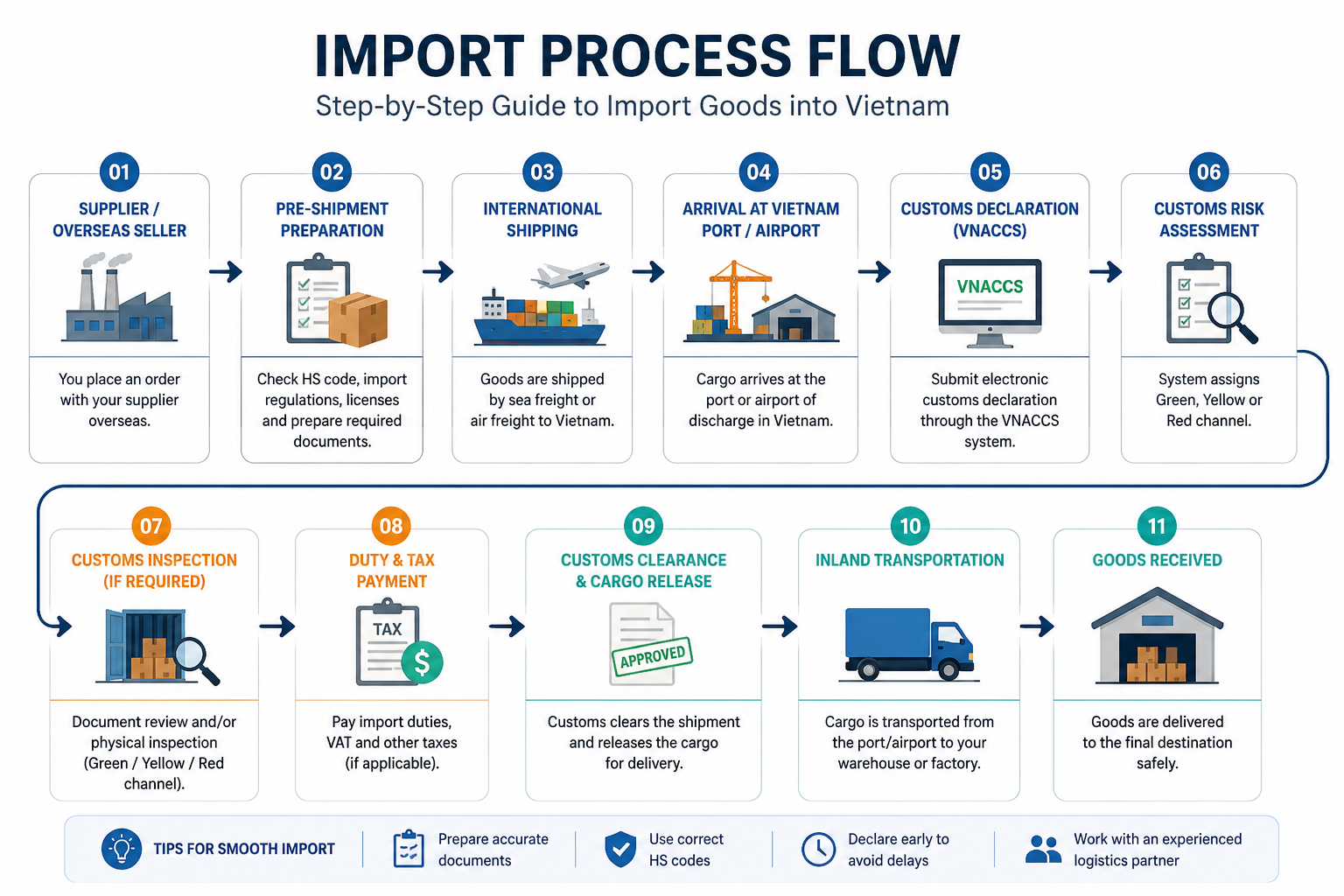
2. Step-by-Step Process to Import Goods into Vietnam
Vietnam’s customs process is highly digitized, yet it requires precise documentation. Any discrepancy between your paperwork and the actual cargo can result in severe fines or port storage delays.
The standard import workflow follows these crucial phases:
Check HS Codes and Duties: Pre-Shipping Phase.
Identify the correct Harmonized System (HS) code for your products to determine the import tariff rates, VAT, and whether the goods require special import licenses.
Prepare the Customs Documents: Before Arrival.
Gather all essential shipping documents: Commercial Invoice, Bill of Lading, Packing List, Certificate of Origin (C/O), and specific ministerial permits.
Submit Electronic Declaration: Within 30 Days of Arrival.
Transmit the customs data through the VNACCS system. Per Vietnam Customs Law, this must be submitted before arrival or within 30 days of the cargo reaching the border gate.
System Inspection and Clearance: At the Port/Airport.
Await the system's traffic-light routing result (Green, Yellow, or Red) to clear and pick up your cargo. Pay the required import duties and taxes.
3. Understanding Vietnam's Customs Inspection Channels
Once your electronic declaration is submitted, the VNACCS system automatically categorizes your shipment into one of three risk management channels:
|
Channel Color |
What it Means |
Required Action |
Average Time |
|
Green (Luồng Xanh) |
Low Risk |
Automated clearance. No physical or document review needed. Goods are released instantly upon tax payment. |
A few minutes |
|
Yellow (Luồng Vàng) |
Medium Risk |
Customs officers conduct a strict document review. If inconsistencies are found, it may be downgraded to Red. |
A few hours (If documents match) |
|
Red (Luồng Đỏ) |
High Risk |
Full document review AND physical cargo inspection (either via port scanner or manual container opening). |
2 - 5 Days (Depending on port congestion, customs inspection, and additional information requested by customs authorities) |
Delays commonly occur when:
- Documents are inconsistent
- HS codes are incorrect
- Product licenses are missing
- Declared values are questioned
Businesses that prepare properly often experience significantly smoother customs clearance
4. Required Documents for Importing to Vietnam
To ensure a seamless Green, Yellow or Red channel processing, your standard customs dossier must include:
- Commercial Invoice & Packing List
- Bill of Lading (B/L) or Air Waybill (AWB)
- Customs Import Declaration Form (Form HQ/2015/NK)
- Certificate of Origin (C/O): Vital for claiming preferential tariff rates under Vietnam's vast network of Free Trade Agreements (like EVFTA, CPTPP, RCEP).
- Technical Compliance Certificates: For regulated goods (e.g., food safety certifications, phytosanitary certificates, or ICT conformity markings, Certificate of Quality, Catalogue…)
5. Common Mistakes Foreign Companies Make When Importing into Vietnam
Even experienced international businesses sometimes face avoidable delays.
Below are some of the most common mistakes:
► Shipping Before Checking Regulations
Not every product can be imported under the same rules. Some categories require Product registration, Technical compliance checks, Import permits, Specialized inspections.
Sending cargo before understanding requirements may result in costly delays.
► Incorrect HS Code Classification
Misclassification can affect: Tax rates, Customs procedures, Licensing obligations, Inspection requirements
Even a small mistake may lead to penalties or additional customs review.
► Incomplete Documentation
Missing or inconsistent paperwork remains one of the biggest causes of customs delays.
Businesses should carefully review:
- Commercial invoice
- Packing list
- Bill of lading or airway bill
- Product certifications
- Country of origin documents
Consistency across documents is critical.
► Choosing the Wrong Shipping Method
Selecting air freight for low-value bulky cargo can increase logistics costs unnecessarily.
Likewise, relying only on sea freight for urgent operational cargo may disrupt production schedules.
The most efficient import strategy often combines both sea freight and air freight depending on urgency and cargo profile.
6. Underestimating Local Logistics Complexity
Many overseas companies focus only on international shipping but overlook:
- Customs coordination
- Port handling (such as THC, D/O, cleaning fee, CIC, EFM, storage charge…)
- Warehousing
- Inland trucking (Lift on, Lift off charges, truck detention …)
- Final delivery
7. How to Optimize Your Import Costs and Timelines
Importing into a dynamic market like Vietnam requires local agility. To minimize risk, international businesses should focus on three core pillars:
Leverage FTAs Wisely: Always check if your country of origin qualifies for reduced tariffs under Vietnam's active FTAs. Vietnam currently maintains over 17 active Free Trade Agreements (FTAs), including EVFTA, CPTPP, RCEP, and UKVFTA, providing preferential tariff treatment for eligible imports. Ensure your C/O meets the specific criteria updated by the Ministry of Industry and Trade.
Declare Early: Do not wait for the vessel to berth. Prepare your paperwork and submit data early to flag any missing certifications.
Partner with an Experienced Local Forwarder: A licensed customs broker can anticipate port bottleneck trends, manage complex commodity codes, and interface directly with customs officials on your behalf.
Streamline Your Vietnam Imports with TAM Logistics
Whether you need sea freight, air freight, customs clearance, or end-to-end logistics support, TAM Logistics helps international businesses simplify the shipping and import process in Vietnam.
Contact TAM Logistics today for a free consultation:
- Email: admin@tamlog.vn
- WhatsApp: +8493 414 0899
main.comment_read_more